Alaska Fiscal Policy| A Discussion with Paul Jenkins

Paul Jenkins

Paul Jenkins, from the Anchorage Daily Planet,  is sitting in as guest host this week on The Mike Pocaro Radio Show and asked me to join him yesterday (1.9.2013) afternoon to talk about Alaska fiscal policy.  The Planet had editorialized earlier in the day (“More Swell News“) on the report on Alaska fiscal policy released last week by the University of Alaska’s Institute for Social and Economic Research (“Maximum Sustainable Yield:  FY 2014 Update“).

The Daily Planet’s editorial concluded: Continue reading

Alaska Fiscal Policy| The Fairbanks News-Miner Gets It

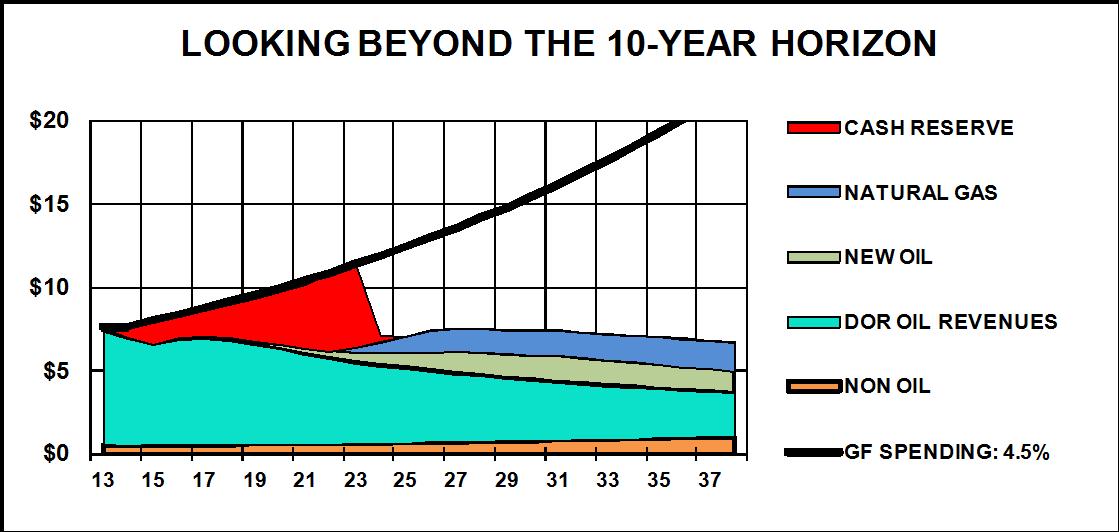
Web Note 14 10-year chartIn an editorial Sunday, the Fairbanks News-Miner focused on fiscal reform, the issue that, in my opinion, is the most important this coming legislative session (yes, even more important than oil tax reform, although that is a close second).

I have only one disagreement with the editorial — the assertion that “the crisis is not yet upon us.”   As the graphic from the ISER study discussed in the editorial makes clear, the deficits are clearly in sight and the only time to address them is now, while oil revenues remain relatively high.  But other than for that matter of perspective, the News-Miner gets it.  The full editorial follows: Continue reading

A Serious Wake-Up Call from ISER: “In fiscal year 2014, Alaska’s state government can afford to spend about $5.5 billion.”

Web Note 14The University of Alaska – Anchorage’s Institute of Social and Economic Research (ISER) today issued its FY 2014 update on sustainable spending levels.  The conclusion, “[i]n fiscal year 2014, Alaska’s state government can afford to spend about $5.5 billion.”

The comparable number in the Governor’s proposed budget is $6.5 billion, and the Governor has said that he would accept the Legislature raising that number even higher (to $7 billion). Continue reading

The Fourth in the Alaska Business Monthly Series: “Alaska Oil Policy| Achieving Alignment” (from the January 2013 Alaska Business Monthly)

January 2013 Alaska Business MonthlyAs noted on these pages previously, I write a bi-monthly column on oil & gas issues for the Alaska Business Monthly.  This is the fourth column, originally published in the January 2013 print edition and available online here.

The last column in this series (“Out of Alignment,” Alaska Business Monthly, November 2012) focused on the reasons why Alaska oil policy is misaligned with the objective of maximizing the development of the state’s oil and gas resources.

The column discussed the state’s attempted use of two tools—tax credits and direct regulatory intervention—to steer investment to Alaska and why those tools have failed to produce significant results in terms of increased production. As I explained, the state’s use of the tools has been similar to backseat driving—and just about as successful.

The column also briefly mentioned a potential solution to the state’s alignment problem—developing a means for the state to co-invest alongside industry in the development of the state’s oil and gas resources. This month’s column further explains that concept. Continue reading

Alaska Fiscal Policy| On the Dan Fagan Show Wednesday (Jan. 2)

Dan Fagan ShowI will be on the Dan Fagan Show this Wednesday — the day after New Year’s — to discuss the Governor’s proposed budget, Alaska fiscal policy and the upcoming legislative session.   Most readers will have seen my initial reaction to the budget on these pages.  If not, they are captured in the following post from earlier this month, “Five takeaways from the Governor’s proposed budget …,” Dec. 18, 2012. Continue reading

Alaska Fiscal Policy| Another reason to be concerned about state spending, NOW …

Fiscal Cliff

In a longer post earlier this week I expressed serious concerns about the level of spending proposed by the Governor in his recently announced FY 2014 budget.  See “Five takeaways from the Governor’s proposed budget …” (Dec. 18, 2012).

As I have continued to work through the budget, additional reasons are becoming apparent which underscore why it is critical that state spending be reduced now.  One in particular caught my attention yesterday. Continue reading

“Five takeaways from the Governor’s proposed budget …”: The Radio Interview

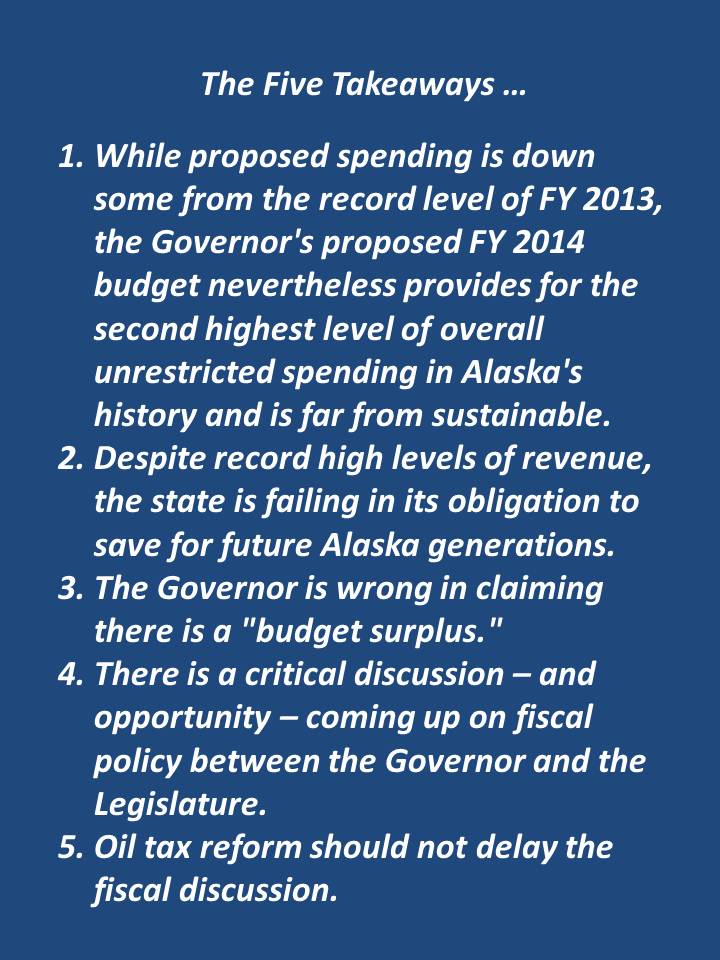
Casey Reynolds ShowOver the weekend I put together a piece that reflects my initial reactions to the Governor’s proposed budget for the coming fiscal year, which he announced Friday.  Entitled “Five takeaways from the Governor’s proposed budget … ,” the piece summarizes my disappointment with the overall size of the proposed budget, and the implications of the budget for current and future Alaskans.  While interested readers can click on the link above for the full article, the headlines follow: Continue reading

Five takeaways from the Governor’s proposed budget …

Five takeaways from the budget ... (12.18.2012)Last Friday (December 14), Governor Parnell announced the Administration’s proposed state budget for Fiscal Year 2014. The full speech is available here. Later in the day, the Administration’s Office of Management and Budget released a more detailed summary of the budget and the Executive Summary of the 10-year forecast, required by the Executive Budget Act, that will accompany the budget submission at the start of the legislative session.

The proposed budget is the first in a constitutionally (Art. IX) and statutorily (AS 37.07) outlined process – normally containing three steps – that ultimately will determine the final state budget for the coming fiscal year. The second step is review and revision of the Governor’s proposed budget by the Legislature, ultimately leading to the passage of its own version of the budget. The third step is subsequent review of the legislatively approved budget by the Governor and, if appropriate, vetoes of various appropriations contained in the Legislature’s budget (the so-called, “line item veto” provided by Art. II, Sec. 15 of the Alaska Constitution). In extreme cases, there is some potential for a fourth step should the Legislature decide that the Governor’s vetoes are excessive; the Legislature can (but very seldom does) override any of the vetoes by a two-thirds vote, reinstituting the specific appropriations otherwise stricken by the Governor. Continue reading

A Success …

Energy in Alaska 2012_Page_1With thanks to my Co-Chair Mark Johnson, the General Counsel of Chugach Electric Association, the Eighth Annual (2012) Energy in Alaska conference closed yesterday as another success.  Yesterday’s panels included Senator Cathy Giessel, Department of Natural Resources Commissioner Dan Sullivan, Department of Environmental Conservation Commissioner Larry Hartig, Alaska Oil & Gas Commission Chair Cathy Foerster, Alaska Energy Authority Deputy Director Gene Therriault, Brent Petrie from the Alaska Village Electric Cooperative and Steve Pratt from Anchorage Mayor Dan Sullivan’s Energy Task Force, along with a number of lawyers in private practice.

The day before we were privileged to have Rep. Bob Herron, ML&P General Manager Jim Posey, MEA General Manager Joe Griffith, Dave Haugen, Director, Project Management of the Alaska Gasline Development Corp.  Jim Strandberg, also  from the AEA, Dr. Paul Carpenter, Chairman and Principal of the Brattle Group and Damian Bilbao from BP, again along with a number of lawyers in private practice.
Alaska OCS Development (Dec 3)As part of the Alaska OCS panel, I gave an update on Continue reading

“Don’t tax you, don’t tax me, tax that fellow behind the tree …”

Republished from “Observations & Updates” (Nov. 4, 2012).

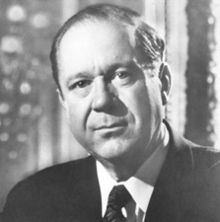
220px-Russell_B._LongFor a time earlier in my life I lived in Louisiana.  During that period I became fascinated with the Long’s — Huey and his son, Russell, who during part of the time I lived in the state served as Louisiana’s senior United States Senator.

Both Long’s were the source of great quotes during their lifetime.  One of Russell’s returned to me this morning as I was reading an article from yesterday’s Fairbanks News-Miner.

The article — Armstrong Oil and Gas chairman talks future of Alaska oil — reports on recent remarks made by Bill Armstrong, chairman of independent oil producer Armstrong Oil and Gas.  The company is active in trying to develop new fields on the North Slope, and recently also developed a new field on the Kenai Peninsula. Continue reading