“Five things to look for in oil tax reform”: The radio interview

Casey Reynolds ShowLate last week I put together a piece that attracted some attention.  Entitled “Five things to look for in oil tax reform …,” the piece summarized the important characteristics that I will look for in evaluating various  proposed approaches to oil tax reform this coming legislature.

This week, Casey Reynolds had me on the Casey Reynolds Radio Show for an hour to discuss the piece and go through all five issues, one-by-one.    It is one of the best public discussions on the issue I have been involved with, inside or outside a radio or TV studio. Continue reading

Five things to look for in oil tax reform …

Politico, a mostly online newspaper that covers national political affairs — and with which I often open my mornings — routinely attempts to provide readers with a guide to significant upcoming events with a list — usually five — of what they consider the most important things to look for as the event unfolds.

As Alaska begins to consider  changing its approach to oil taxes in the upcoming session, I have developed a list of five characteristics that I will look for in evaluating various proposals.  I share them for whatever value that may have to others. Continue reading

“Energy in Alaska” 2012

Mark Johnson, the General Counsel of Chugach Electric Association, Inc., and I are Co-Chairs the week after next (Monday and Tuesday, December 3 and 4) of a two-day conference on Energy in Alaska.  The conference does not focus just on the North Slope, or the Cook Inlet, or the OCS, or oil and gas, or electricity, or the instate energy crisis, or federal, or state issues.

Instead, uniquely among Alaska energy conferences, it covers all of the above, providing a pre-session review of both state and federal issues likely to be of interest in the coming legislative and business years.  I am honored to be serving my third year as Co-Chair of the Conference, the last two with Mark. Continue reading

Alaska Fiscal & Oil Policy| Now the really hard work begins …

The election results from last week have put Alaska Republicans clearly in charge of the Governorship, state House and state Senate for the first time  since 2006, when the Senate coalition was first formed.

As difficult as the election battles may have been, however, the hard work is only now beginning.

Most successful R candidates said during their interviews on local television stations election night that oil tax reform is their highest priority.  The Governor said the same. Continue reading

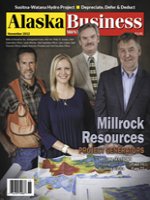
The Third in the Alaska Business Monthly series: “Alaska Oil Policy| Out of Alignment” (from the November 2012 Alaska Business Monthly)

As noted on these pages previously, recently I agreed to write a bi-monthly column on oil & gas issues for the Alaska Business Monthly.  This is the third column, originally published in the November 2012 print edition and available online here.

 As Alaska finishes this year’s election cycle and starts looking toward the coming legislative session there are several steps which are needed to restore Alaska as an attractive location for oil investment. Continue reading

Rare unanimity of opinion: Vote No on Bonding Proposition A

Click to enlarge

The Fairbanks News Miner editorial page this morning made it official.  The editorial pages of the News Miner, the Anchorage Daily News, the conservative Anchorage Daily Planet (Paul Jenkins and Tom Brennan’s outlet), and Dermot Cole (the News Miner‘s lead columnist), amazingly given their different perspectives, all agree on one thing — Alaskans should Vote NO this coming week on Bonding Proposition A.

The Anchorage Daily Planet actually has doubled down on the issue, editorializing against the bond issue both last week (“Who“) and again today (“We’ll be voting no“). Continue reading

An Exchange on the Bond Issue …

The commentary in the next piece down expresses my opposition to Bonding Proposition A appearing on the upcoming general election ballot.  Subsequent to that piece, the Anchorage Daily Planet and Fairbanks News-Miner columnist Dermot Cole also have expressed their opposition here (the Planet) and here (Cole).

The Planet also published a link to my commentary.  Today, coming from that link, I received the following note from former (1992-94) Commerce and Economic Development Commissioner Paul Fuhs.  I regularly receive notes on commentaries from readers  and have received an unusual number of others on the column below. With the exception of the note from Fuhs, however, all of the remainder on this piece have supported the position taken in the commentary and indicated that they also intend to oppose the ballot measure. Continue reading

Alaska Fiscal Policy| Vote No on Bonding Proposition A …

Click to enlarge

In addition to the 59 legislative races that have been — and will continue to be — widely discussed between now and election day, there also are two statewide measures that will appear on the election day ballot.

One is the question, required by the Alaska Constitution to be included on the ballot every ten years, of whether there shall be a new Constitutional Convention called. Continue reading

Guest Column| Brian Hove: Fiscal Plans, Oil Production and Politics…

With this piece by Brian Hove, we kick off our Guest Column series.  Periodically, we will publish pieces written by others which provide additional insights into matters affecting Alaska oil & gas policy.  As Brian notes, this article further develops one of the points made in a piece published earlier this month in Oil & Gas Finance Journal by former Department of Revenue oil economist and current consultant Roger Marks.

Brad Keithley’s September 19th blog entry poses the question “What is Alaska’s fiscal plan…” for which he offers a good working definition: “an outline of the government’s long term revenue and expense projections, designed to achieve balance.” Continue reading

Don Smith for Senate H …

With all due respect to those on both sides of the debate, at this point oil reform is only the second most important issue to Alaska’s future.  Right now, reforming Alaska’s fiscal policy should take priority.

Alaska is at a crossroads.  As I have explained elsewhere on these pages, continuing the current levels of state spending will doom future Alaskans to a lower standard of living, either as a result of reduced state goods and services or the need to implement state income, sales and property taxes to sustain them.  As current spending rates, oil reform may delay that result, but it will not change it. Continue reading