Sunday Morning Note (Aug 16, 2015) …

Sunday Morning Note ...Last week we started on Page Two of this blog a new weekly column, “Sunday Morning Note ….”  As we said there, “Sunday mornings are normally the time that I sit back, make an extra pot of coffee, and catch up on some of the past week’s data. Since I am doing them in any event I thought I would start throwing them up here, both as another place to capture them and to make them available to anyone else who may find them of value.”
Last week’s Note is available here.  Based on the strong response, this and subsequent weeks we are moving the Note over to the main page as a regular feature of this blog.  It will be used as a place to capture some data, and if useful, a note or two about things that arose during the week  we missed at the time, or are useful to capture again.

This past week’s data: Continue reading

The (much) better economic model for #AKFuture …

ISER Sustainable Budget Model

(Supplemental Note:  Following up on a reader’s suggestion, I published a brief supplement to this piece on 6.15.2015 to make available a couple of graphics reflecting the points made in the following piece.  The supplement is available at “Page Two” of this blog, here.)

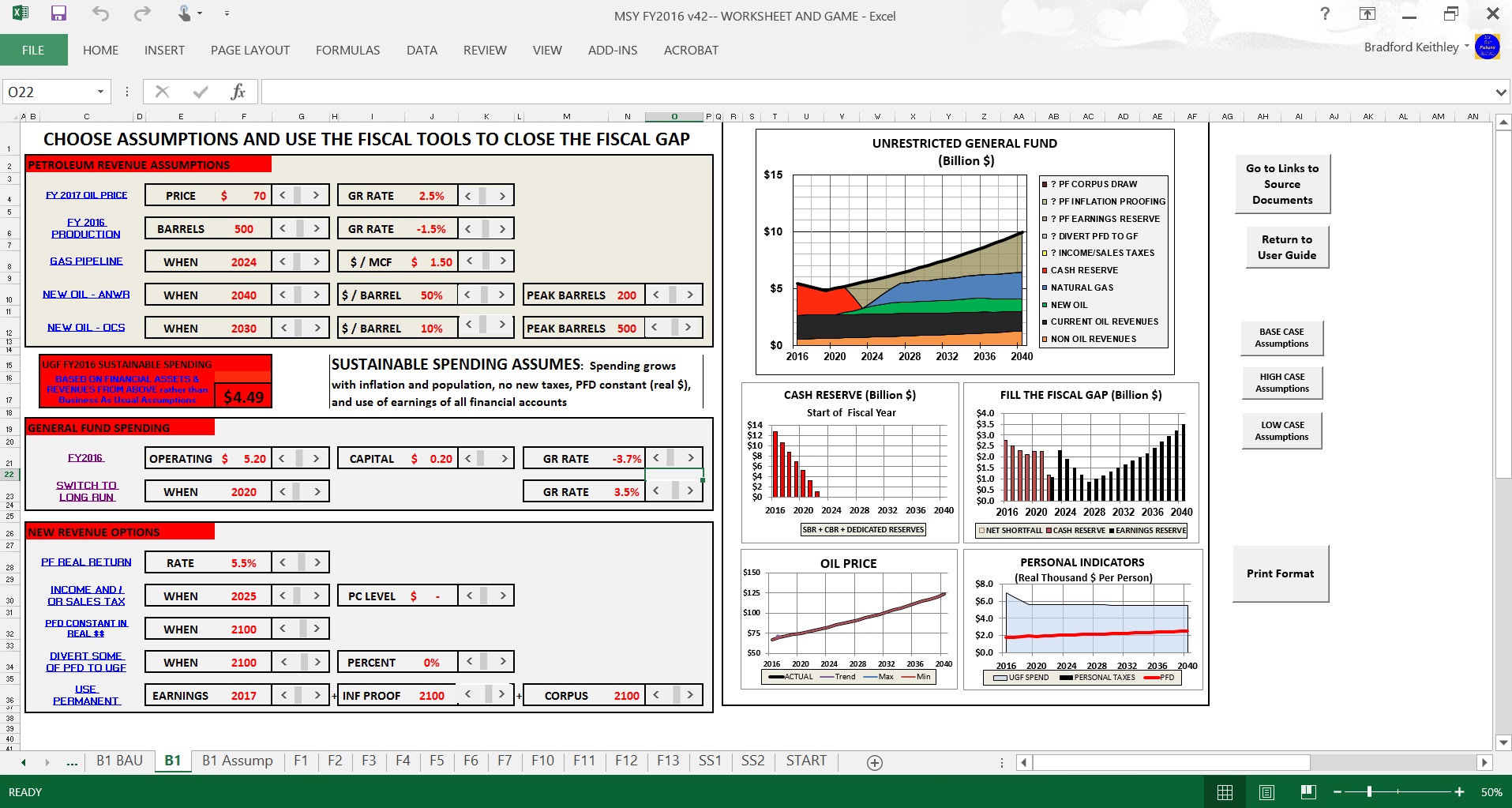
Yesterday, after the legislature finally completed work on and passed the coming year’s (FY 2016) budget, I spent a large part of the day working through the two publicly available economic models recently offered to help Alaskans understand and help plot where the state should be headed going forward.

The first I spent time with was that released last weekend as part of Governor Walker’s “Conversations with Alaskans”.  That model is available for download here (*see additional footnote below). 

The second was that released earlier this year by the University of Alaska-Anchorage’s Institute for Social and Economic Research, the best non-partisan economic think tank in the state.   That model is explained and available for download here.

There are significant differences between the two.  Continue reading

#ShellNo or #ShellYes: A Debate on Arctic Development

Yesterday, Rep. Charisse Millett, Majority Leader, Alaska House of Representatives, Kshama Sawant, a member of the Seattle City Council, Glen Hiemstra, a Futurist and I debated Shell’s Arctic exploration plans on The Stream, a globally broadcast online program from Aljazeera.

Interestingly, the debate mostly turned into a “Seattle trying to tell Alaska how to do things” discussion.  That never ends well for Seattle.

The background and some related materials are available here.  The full debate — which is about 35 minutes — is at the link above and worth the listen if you are interested in the subject.

Time to complete Gov. Hammond’s vision

Hammond bill signingThe following ran as a My Turn piece in both the online and print editions of the Juneau Empire under the headline “Time to complete Governor Hammond’s vision” (Tuesday, May 12, 2015), as a Community Perspective piece in both the online and print editions of the Fairbanks News-Miner under the same headline (Thursday, May 21, 2015), and as a Commentary in both the online (Friday, May 22, 2015) and print (Saturday, May 23, 2015) editions of the Alaska Dispatch News under the headline “It’s time to use Permanent Fund earnings for government services.”

Former Governor Jay Hammond said this when later describing the reasons he and others created the Permanent Fund:  “I wanted to transform oil wells pumping oil for a finite period into money wells pumping money for infinity.”  Once the money wells were pumping, “[e]ach year one-half of the account’s earnings would be dispersed among Alaska residents …. The other half of the earnings could be used for essential government services.”

The two-sentence constitutional provision establishing the Permanent Fund (Art. 9, Section 15) implements that vision.  The first sentence locks away the “the principal” of the Permanent Fund, creating the “money wells pumping money for infinity.”

The second sentence provides the vehicle for using the resulting “production,” by directing that “[a]ll income from the permanent fund shall be deposited in the general fund unless otherwise provided by law.” Four years after voters established the Permanent Fund the legislature solidified the direction, providing that that the income stream is to be used for three purposes:  to pay dividends, to protect the principal from inflation and to fund a reserve account, available when needed to pay for essential government services. Continue reading

Alaska’s Budget: Status, Background and Where We Are Headed Next

Earlier this month I was asked to make a presentation at the Annual Meeting of the Alaska Republican Assembly on the current state of Alaska’s budget.  A video of a portion of the presentation is at the top; the slidedeck I used below it.

Toward the end of the videotaped portion I was asked “if I were King” how I would deal with the resolving the current (FY 2016) budget stalemate.  The answer begins at 39:45 of the video.

Alaska’s Fiscal Challenge: How deep, how long, potential solutions and what they mean for Anchorage

Last month, Joe Riggs, a member of the Anchorage Mayor’s Budget Advisory Commission, and I were asked to make a presentation to the Commission on the current state of the Alaska state budget and the potential implications for the Municipality’s budget.

The conclusion?  Continuing reductions in state support, and, potentially, encroachment on the Municipality’s revenue options.  In other words, squeezed from both ends.

The slide deck we used is at the link above, or available here.

The most important thought piece this year …

ClarityThe Alaska Dispatch News last week published what is likely the most important thought piece — at least on fiscal policy — yet this year.

Cutting through the fiscal cacophony currently rampant in Juneau and elsewhere, UAA Professor Emeritus and former ISER Director Dr. Scott Goldsmith said this about the state’s current fiscal crisis:

But we don’t have to go down that path. If managed properly, income from Alaska’s assets — oil revenues and earnings from all our financial accounts (including the Permanent Fund, which was created to take over the support of public services from declining petroleum revenues) — can sustain both a $2,000 dividend and a stable and predictable state budget of about $4.5 billion, growing with inflation and population, long into the future.

The full piece is here.  If you care anything about this issue — and all Alaskans should — you should read it … maybe several times.

Alaska’s true fiscal picture …

Fiscal TransparencyLast Friday, the Department of Revenue issued the Spring 2015 update to the Fall 2014 Revenue Sources Book (RSB).  Among other things, each year the Fall Book contains a forward look at the revenue portion of the state’s fiscal condition over the next 10 years.  As the legislature and Governor finalize the upcoming year’s budget, the Spring update revises that forecast, usually focused on the next two years, for known and measurable changes occurring since the Fall forecast.

While DOR adjusted the first two years at the time it issued the Fall Book, the oil prices contained in the Fall Book largely were set last October, before the full outlines of the 2015 oil price plunge were known.  As a result, while the Fall Book gave observers a feel for where Alaska’s financials were headed the next two years, the primary forecasts contained in the Fall Book did little to provide a realistic picture beyond that.

The Spring update starts down that road by revising the oil price forecast across the same ten year period as the Fall Book.  While some, including me, may argue that even the Spring update paints too rosy a picture of future oil prices — for example, the Spring update forecasts the FY 2022 oil price to average at around $102; as of this writing, the current futures market prices for the same period level out at $77 (Brent) and $66 (WTI) — it nevertheless is a more realistic picture than derived from the Fall Book. Continue reading

Breaking Bad: House Finance starts “sponsoring” talks on taxes and the PFD …

Screenshot 2015-03-29 14.48.29Last Thursday the House Finance Committee sponsored — not just presented or hosted, but sponsored — a “lunch and learn” entitled “Fiscal Reality – Exploring Scenarios to Reclaim Budget Solvency.”  A video of the presentation is available here

As the Alaska Dispatch reported after, the presentation focused mostly on options to raise revenue.

New revenues could come from things like income taxes, sales taxes or other taxes, he said. … Teal also showed several options for using the Permanent Fund to close the gap. One option is spending the earnings reserve, which the Legislature can do now legally but not necessarily politically. It could also switch to an endowment-type system called percent of market value ….

Toward the end of the presentation, Rep. Steve Thompson, the House Finance Co-Chair who moderated the presentation (Vice Chair Rep. Dan Saddler is in the picture above next to him) said one reason for the presentation was because he and others were concerned that cutting state spending too deeply could “crash” the economy, and that it was time to start discussing options to avoid that.

But neither Rep. Thompson, Rep. Saddler nor anyone else during the presentation acknowledged that taking money out of the private economy — which both taxes and cutting the Permanent Fund Dividend would do — would simply transfer the pain to private sector participants, and potentially leave Alaskans as a whole far worse off.   Continue reading

The Alaska budget, the state legislature, percentages and other significant numbers …

The Alaska State Capitol building, Downtown Juneau, Alaska.Percentages and other numbers are interesting things.  By selecting different sets you can make things look small or large.

For example, Rep. Lora Reinbold defended her vote last Thursday against the Operating Budget in part using a percentage, claiming that the proposed budget only cut 5% from spending.  Looking at the actual numbers compiled by the Legislative Finance Division (LegFinance) tells a different story, however.

Using LegFinance’s analysis of the final House bill as a base, Rep. Reinbold’s percentage is right if you focus only on certain categories of state spending (what collectively are referred to as “Agency Budgets”), and compare only what those familiar with these things refer to as the FY 16 Adjusted Base (essentially the spending level for FY 2015 adjusted for “normal” year to year changes) against the proposed FY 2016 spending level before the House Continue reading