My letter to ASD on the proposed curriculum on Alaska’s Fiscal Future …

letterLast Thursday Governor Walker’s office issued a press release announcing that, the following day at an in service training for some of its middle and high school teachers, the Anchorage School District intended to start rolling out proposed course materials “to bring Alaska’s fiscal challenge to the classroom.”  That was the first I, and from various reactions, a large number of others had heard about the intent to do so.

What caught my eye about the proposal was the following statement in the Governor’s press release:  “the lesson plans center on Alaska’s Revenue and Expenditure Model developed earlier this year by the Alaska Department of Revenue.”

As readers of these pages likely already realize I am not a fan of the Department of Revenue’s model.  As I wrote on these pages in June, in my view DOR’s model then was short-sited and strongly biased toward requiring new revenue options.  While there have been some improvements made in the model since the version I reviewed in that piece, it continues to contain limitations and deficiencies which continue to drive users toward those options.

More importantly, the model fails to identify and lead users to understand — and find pathways to solve — the structural defects in Alaska’s current fiscal model.  Following oil price and production ups and downs, Alaska’s historic fiscal approach repeatedly has led to boom and bust cycles in government spending over the last several decades.  Rather than address that fundamental issue, which goes to the heart of Alaska’s current fiscal situation, DOR’s model instead merely leads users to try to find ways to fill in the current bust cycle with “new revenues” — largely a PFD cap and broad based taxes. Continue reading

Weathering Alaska’s Fiscal Storm …

At the request of the University of Alaska-Fairbanks student group, Students Who Enjoy Economic Thinkingyesterday Dr. Scott Goldsmith and I walked through a discussion of sustainable budgets at a forum on the UAF campus.  The slide deck we used is above.

It was an interesting discussion, with excellent questions.  For those interested, a summary written by News Miner political reporter Matt Buxton is in today’s paper, here (“Keithley, Goldsmith talk sustainable budget“).  My favorite quote in the story is this, quoting Scott:

He said the state has often fallen into the trap of increasing budgets when oil tax revenue is high and painfully cutting when it collapses.

“What it means is we’re having a party and passing the cost of the clean up to the next generations of Alaskans. We have to ask ourselves, ‘Is that fair?’” he said.

The solution?  Well, read the slidedeck.

Sunday Morning Note (Sept. 20, 2015) …

Sunday Morning Note ...As usual, we start this week’s note with last week’s data.

On the oil side, last week near term prices largely remained stable from the week before, and while longer term prices last week drifted downward somewhat from the previous week, they nevertheless continued to remain ahead of where they were a month ago, reflecting continuing confidence that oil prices will recover after the current supply overhang dissipates.

Here is the chart reflecting the closing prices this past Friday (an explanation of the source of the data is here) : Continue reading

Alaska’s Fiscal & Economic Future …

“Here’s My Proposal” (1hr, 50 min)

Fashioning a Compromise (38 min)

Fashioning a Compromise (38 min)

While I work on this week’s Sunday Morning Note here are the segments from Saturday’s  (Sept. 19, 2015) forum on Alaska’s Fiscal & Economic Future that featured the “citizen proposals” offered by former Attorney General John Havelock, First Alaskans Institute CEO/President Elizabeth Medicine-Crow, former Senator Gary Wilken, and me.  A copy of the proposals prepared by each are available here.

The first segment (“Here is My Proposal”) is the presentation of the proposals, questions from the panelists to each other, and questions of the panelists by former Deputy Revenue Commissioner (among other things) Larry Persily, Legislative Finance Director David Teal and conference organizers Gunnar Knapp (Director of the Institute of Social and Economic Research) and Cliff Groh (Chair, Alaska Common Ground).

Following an announcement of the results of the polling conducted after the first segment, the second segment (“Fashioning a Compromise”) is a discussion among the panelists of the factors involved in reaching a compromise among the various positions, and an outline of what form a compromise might take.

My proposal at tomorrow’s “Forum on Alaska’s Fiscal and Economic Future” …

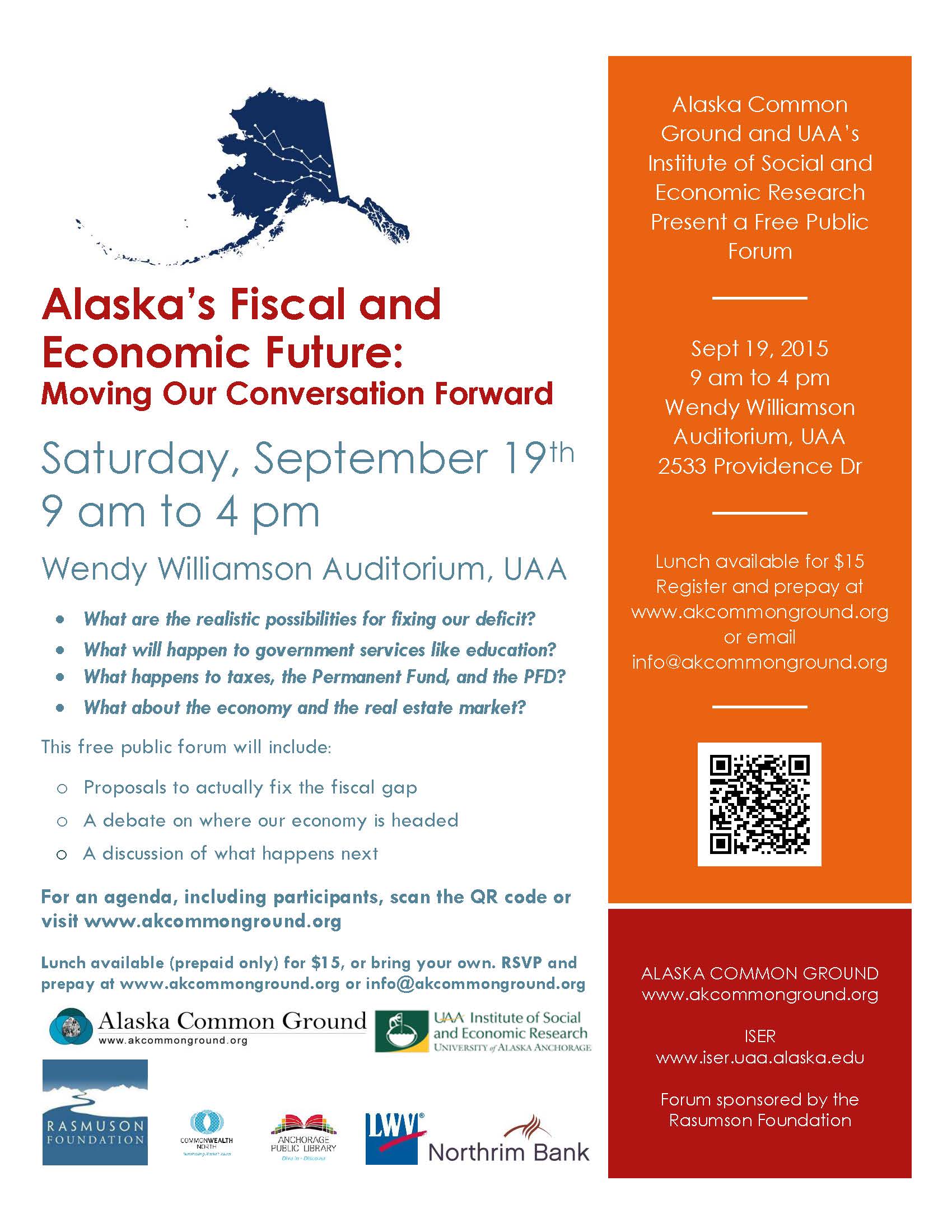
Alaska's Fiscal and Economic Future ForumAs most readers likely are already aware, tomorrow (Saturday, September 19, 2015) Alaska Common Ground and the University of Alaska – Anchorage Institute of Social and Economic Research (“ISER”) are sponsoring a day long forum on Alaska’s fiscal and economic future.  A description of the forum and detailed agenda is available here.

The forum is from 9am – 4pm, at the Wendy Williamson Auditorium located on UAA’s campus.  For those unable to attend in person, the forum will also be televised live on 360 North, the same public television system that televises Gavel-to-Gavel.

Based on the agenda and discussions with both those who have brought it together and various speakers, I anticipiate it will be a significant event in shaping the course of the coming debate on Alaska’s fiscal future.

One part of the forum will involve presentations by four Alaskans, each of whom will discuss and defend their own budget proposals, with audience members voting after the presentations on which they favor.  Those presenting are John Havelock, former Alaska attorney general; Liz Medicine Crow, president/CEO, First Alaskans Institute; Gary Wilken, former Alaska state senator … and me.

Those interrogating the panelists about their proposals (I am confident in a good sense of the word — hahahaha) are  Cliff Groh, Chair of Alaska Common Ground; Gunnar Knapp, ISER director and professor of economics; David Teal, director, Alaska Legislative Finance Division; and Larry Persily, former federal coordinator of the Alaska Natural Gas Pipeline Project, and former deputy commissioner, Alaska Department of Revenue.

Somewhere along the way I can guarantee I will mumble to myself (because I always do), “why did I agree to do this?” … and somewhere later along the way I will realize the answer.

Each of the “citizen panelists” has been asked to provide materials explaining and supporting the position.  These will both be handed out to those attending in person and available online for those tuning in via web or television.  For any that want to have a flavor for what is likely to be discussed — or get a jump in formulating questions, my set follows.

We will see how this goes ………

My current “Top 5” #AKbudget priorities for the 2016 session …

In preparation for the coming week — the discussion today on Alaska Public Radio Network’s Talk of Alaska, a meeting this evening of the Alaska Republican Assembly and my participation in Saturday’s forum on Alaska’s Fiscal and Economic Future — I have been working to refine my focus for the coming 2016 legislative session (which will set the FY 2017 budget) to five top priorities.

Here is the slide deck that captures my current view.

Sunday Morning Note (Sept 13, 2015) …

Sunday Morning Note ...As usual we start with this past week’s data.   Although nearer term oil prices (2015, 2016 and 2017) moved down slightly on the week reflecting continued concerns about the current supply overhang, longer term prices either held steady (largely the story for 2018) or, in fact, advanced (2020) as the market appeared to come to rest for the moment on the belief that the current oversupplied condition isn’t a permanent affliction and that, at some point, the market will start reflecting the long-run marginal cost of production.

Here is the chart reflecting the closing prices this past Friday (an explanation of the source of the data is here) : Continue reading

Sunday Morning Note (Sept 6, 2015) …

Sunday Morning Note ...As usual, we start with this past week’s data.  After undergoing a considerable run up at the close of the previous week that extended into Monday of this week with next month WTI approaching $50 and Brent nearing $55 , trading the remainder of the week  drifted downward to close in the mid-$40’s for WTI and short of $50 for Brent.

Here is the chart reflecting the closing prices this past Friday (an explanation of the source of the data is here) : Continue reading

Sunday Morning Note (Aug 30, 2015) …

Sunday Morning Note ...(Background on the source and purpose of the Sunday Morning Note is here.)

As usual, we start with this past week’s data.  After opening the week very roughly on the back of data indicating continued problems with Chinese demand, oil prices recovered sharply by the end of the week to close higher not only compared with the lows encountered at the start of the current week, but also even from the first of the month.

Here is the chart reflecting the closing prices this past Friday (an explanation of the source of the data is here); :

Sunday Note (8.30.2015)

Continue reading

Sunday Morning Note (Aug 23, 2015) …

Sunday Morning Note ...A couple of weeks ago I started writing the Sunday Morning Note as a place to capture and make available data from the prior week and from time to time, a note or two if useful about things that arose during the week we may have missed, or are useful to capture again.

In this week’s Note we substitute for the latter a comment about an Alaska legislative hearing of significance this upcoming week.

We start, as before, with this past week’s data: Continue reading