Posted onNovember 12, 2016|Comments Off on Two questions for Senate President Kevin Meyer this coming Tuesday …
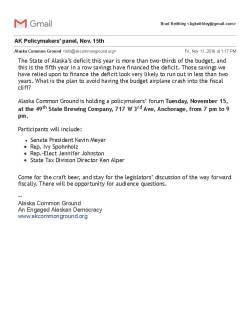
This coming Tuesday evening Alaska Common Ground is hosting a post-election panel discussion on Alaska’s fiscal situation. On the panel are Senate President Kevin Meyer, Rep. Ivy Spohnholz, Rep.-Elect Jennifer Johnston, State Tax Division Director Ken Alper.
According to the invitation (at left), the question being put to the panel is this:
The State of Alaska’s deficit this year is more than two-thirds of the budget, and this is the fifth year in a row savings have financed the deficit. Those savings we have relied upon to finance the deficit look very likely to run out in less than two years. What is the plan to avoid having the budget airplane crash into the fiscal cliff?
While artfully phrased, the set up — “the savings we have relied upon” — leaves a significantly misplaced impression. Continue reading →
Posted onNovember 11, 2016|Comments Off on “Fiscal Friday” on The Michael Dukes Show (Nov. 11, 2016)
As regular readers know, each Tuesday morning at 7:20 am Alaska, I join KBYR AM700‘sThe Michael Dukes Show to discuss the latest in Alaska oil and fiscal issues. This week I also sat in for a day as guest host of Friday’s show while Michael took a well deserved break.
We turned part of the show into “Fiscal Friday,” using it as an opportunity to take a deeper dive into some of the important issues surrounding Alaska’s budget situation. We broke the discussion into two parts.
Part 1 includes:
An overview of the three critical steps involved in setting a budget (determining the approach, projecting revenues and setting spending)(from 1:55 to 13:40 of the podcast),
A discussion with Rep. Lynn Gattis on what lies ahead in the coming legislative session on fiscal issues (from 14:25 to 29:25), and
A discussion with former Senate President and Walker Transition Team Co-Head Rick Halford on the Permanent Fund, the Permanent Fund Dividend and the “other 50” of the Permanent Fund earnings stream (from 30:25 to the end).
Part 2 includes a discussion during the first part of the third hour about budgeting decisions being made at the University of Alaska, and how those relate to the state’s fiscal situation (from 04:55 to 12:45).
Links to background articles and some of the materials referenced during the discussion are available here.
Listen here or at the widget below. For past episodes of our ongoing discussion with Michael Dukes on these issues, go here.
Posted onNovember 8, 2016|Comments Off on This week (Nov 8, 2016) on The Michael Dukes Show …
Each Tuesday morning at 7:20 am Alaska, I join KBYR AM700‘sThe Michael Dukes Show to discuss the latest in Alaska oil and fiscal issues. This week Michael and discuss my final election thoughts — as we near the end, who are the core fiscal conservatives and who’s just posing — and my take on Charles Wohlforth’s ADN column on “Stopping oil exploration,” goo.gl/TE7wlX. I join Michael at 15:20 into the segment.
Listen here or at the widget below and for past episodes, go here.
Posted onNovember 1, 2016|Comments Off on Some observations on the Permanent Fund and PFD
Yesterday we posted a commentary focusing on how to implement a portion of Governor Hammond’s still highly relevant vision for the Permanent Fund. See, Fully implementing Governor Hammond’s 50/50 plan (or, how to find another $1.5 billion in revenue without PFD cuts and taxes), https://goo.gl/7Ct8B5.
That piece arose out of some work we have been doing overall on the Permanent Fund in preparation for taking a more active role this upcoming legislative session on fiscal matters as part of the Alaskans for Sustainable Budgetseffort.
Today we spoke to the Alaska Support Industry Alliance “Emerging Leaders” cohort on that and some additional topics related to the Permanent Fund and PFD. The slide deck is above and also available at https://goo.gl/E7mD1L.
Our concluding observations were these:
The earnings stream from the PF is not being used to its maximum potential to help solve the fiscal crisis — Hammond: “The other half of the earnings could be used for essential government services.” It’s time to implement that vision.
How we calculate Hammond’s “other half” is, literally, a billion dollar (annually) issue
Cutting the PFD: — Makes Alaska a much more government-centered economy (more like Angola than Texas), and — Has a large (ISER: the “largest” of all options) adverse impact on the overall Alaska economy
Posted onOctober 31, 2016|Comments Off on Fully implementing Governor Hammond’s 50/50 plan (or, how to find another $1.5 billion in annual revenue without PFD cuts and taxes)…
In discussing the purpose behind the creation of the Permanent Fund and later the Permanent Fund Dividend former Governor Jay Hammond outlined a very simple, two part plan:
The first related to the creation of the Permanent Fund itself:
I wanted to transform oil wells pumping oil for a finite period into money wells pumping money for infinity. …
The second focused on what to do with the earnings, once the “money wells” were pumping:
Each year one-half of the account’s earnings would be dispersed among Alaska residents …. The other half of the earnings could be used for essential government services.” Diapering the Devil, https://goo.gl/FFTi9M at 15, 19.
Through Constitutional amendment (Art. 9, Sec. 15, https://goo.gl/rSxZ9n) and statute (AS37.13.145, https://goo.gl/rfScqh), the state has implemented the first and the first half of the second (“one-half of the account’s earnings would be dispersed among Alaska residents”) parts of the plan.
The state never, however, has implemented the second half of the second part of the plan (“The other half of the earnings could be used for essential government service.”). Instead, the state repeatedly has drawn on savings when it has needed supplemental sources of money to fund essential government services rather than turning to the “other half” of earnings.
Now that some have suggested the use of savings should be reduced — and replaced by taking money from the state’s private economy through PFD cuts and/or taxes — we have examined what it would take to implement the final step of Governor Hammond’s 50/50 plan. Continue reading →
Posted onOctober 25, 2016|Comments Off on Lance Pruitt in East Anchorage House District 27
In June of this year, at the end of what became the next to last extension of the legislature’s 2016 session, the House Finance Committee voted on whether to advance SB 128 to the floor.
That bill, which already had passed the Senate, proposed permanently to cut (what supporters refer to euphemistically as “restructure”) the Permanent Fund Dividend (PFD).
By that point the Alaska economy already was in an economic recession. And the legislature already had been advised by the University of Alaska-Anchorage’s Institute of Social and Economic Research (ISER) — the state’s best economic think tank — that cutting the PFD was the “most regressive”and would have the “largest adverse impact on the [overall Alaska] economy” of all the state’s fiscal options.Short-Run Economic Impacts of Alaska Fiscal Options,https://goo.gl/ZxR1Hw at A-12, A- 15 (March 2016). Continue reading →
Posted onOctober 25, 2016|Comments Off on Aaron Lowjeski in Fairbanks House District 5
As someone who cares deeply about Alaska’s fiscal and economic condition, from time to time I have gone the extra mile to support candidates that I think, if elected, can be positive difference-makers in developing state fiscal policy.
In that vein I am going the extra mile the last two weeks of this election cycle to support Aaron Lojewski in House District 5 (Fairbanks).
The following radio ad and some related digital is going up today and will run through election day.
Posted onOctober 25, 2016|Comments Off on This week (October 25, 2016) on The Michael Dukes Show …
Each Tuesday morning at 7:20 am Alaska, I join KBYR AM700‘sThe Michael Dukes Show to discuss the latest in Alaska oil and fiscal issues. This week Michael and discuss Craig Medred’s piece on the deepening Walker/business divide (goo.gl/Zt7hyL), the Governor’s letter to various business organizations that has most recently escalated the battle (goo.gl/sihnJX), my take on the top 3 fiscal issues this #AKleg election cycle and my view of how some of the candidates stack up on those issues. I join Michael at 14:45 into the segment.
Listen here or at the widget below and for past episodes, go here.
On Friday we rolled out Alaskans for Sustainable BudgetsFY 2018 sustainable budget number in presentations in Fairbanks before the Interior Alaska Republicans, and in the MatSu Valley before the Alaska Republican Assembly. The slide deck is above, as is a video of the presentation Friday evening before the Alaska Republican Assembly. (Note: the video has been added subsequent to the publication of the original post.)
The roll out comes earlier than in past years, as a way of putting an updated, FY 2018 sustainable budget number in front of the Administration and legislators in advance of the election and subsequent organization.
The number is based on oil price projections made by the federal, and non-partisan Energy Information Administration in July of this year as part of its Annual Energy Outlook 2016. While the state also publishes oil price projections, the latest one, published in the Department of Revenue’s Spring 2016 Revenue Sources Book, is significantly out of line with the EIA and other recent forecasts, came in the middle of a debate over whether Alaska needed so-called “new revenues” in which the Administration was pushing a tax and PFD cut narrative based in substantial part on a low oil price future, and thus, quite frankly, is of significantly questionable credibility and value.
Going forward, we at least will use — and will urge others to use — oil price projections published by reputable, non-partisan sources rather than those published by an Administration (whether Republican, Democrat or Independent) pushing a political agenda based on one view or another of oil prices.
The long term sustainable budget number for FY 2018 is $4.02 billion. The material assumptions that go into the calculation are included on the slide deck.
Posted onOctober 18, 2016|Comments Off on This week (October 18, 2016) on The Michael Dukes Show …
Each Tuesday morning at 7:20 am Alaska, I join KBYR AM700‘sThe Michael Dukes Show to discuss the latest in Alaska oil and fiscal issues. This week Michael and I discuss the hardening lines emerging in the runup to the upcoming #AKleg session. Walker takes on business and increasingly signals he is concerned more about the government economy than Alaska’s overall economy, the University gets personal in an attempt to avoid cost cutting & the #AKLNG transition continues, but is it taking the right direction. I join Michael at 14:10 into the segment.
Listen here or at the widget below and for past episodes, go here.

 This coming Tuesday evening Alaska Common Ground is hosting a post-election panel discussion on Alaska’s fiscal situation. On the panel are Senate President Kevin Meyer, Rep. Ivy Spohnholz, Rep.-Elect Jennifer Johnston, State Tax Division Director Ken Alper.
 In discussing the purpose behind the creation of the Permanent Fund and later the Permanent Fund Dividend former Governor Jay Hammond outlined a very simple, two part plan:
 In June of this year, at the end of what became the next to last extension of the legislature’s 2016 session, the House Finance Committee voted on whether to advance
  As someone who cares deeply about Alaska’s fiscal and economic condition, from time to time I have gone the extra mile to support candidates that I think, if elected, can be positive difference-makers in developing state fiscal policy.

 Thoughts on Alaska Oil & Gas
You must be logged in to post a comment.