Category Archives: Immediate Reactions

Why we believe cutting the PFD has the largest adverse impact on the overall Alaska economy …

2016_03_30-shortruneconomicimpactsofalaskafiscaloptions-p-iii-9

Over the last few days we have been engaged in a debate about ISER’s analysis of the economic effects of various fiscal options.  The analysis is contained in a report, Short-Run Economic Impacts of Alaska Fiscal Options, published by ISER last March (the “March 2016 Report”).  Portions of the report were included also in a presentation by ISER this week before the Senate Labor & Commerce Committee (What do we know about the Alaska economy and where is it heading?“).

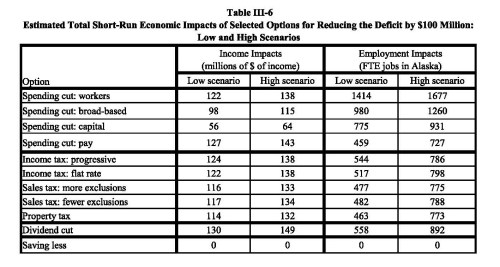
The debate has been about the relative effect of cutting the PFD compared with other options.  While various charts have been used in the course of the debate, the most complete is that above from the March 2016 Report, which shows all of the options and the relative “high” and “low” impact of each separately on overall Alaska income and jobs.

The “Income Impacts” side shows the relative “high” and “low” impact of the various options per $100 million of deficit reduction.  The impacts are shown in terms of the reduction in overall Alaska income by taking a given action.

For example, reducing the deficit by cutting the permanent fund dividend (next to last line) by $100 million (and transferring the money to government) results in a reduction in overall Alaska income of between $130 – $149 million.  On the other hand, reducing the deficit by raising $100 million through sales taxes (fewer exclusions, eighth line) results in a reduction in overall Alaska income of between $117 – $134 million.

Comparing the mid-point of each range — which we have used in various presentations to help simplify the discussion — demonstrates that reducing the deficit through sales taxes reduces overall Alaska income by approximately $125 million, while cutting the PFD results in reducing overall Alaska income by approximately $140 million (per $100 million of reduction).  Because the PFD cut results in a greater reduction in overall Alaska income, the PFD cut has a larger adverse impact on the Alaska economy (measured by income) than raising sales taxes.  

Indeed, looking up and down the chart, cutting the PFD has a larger adverse impact on the Alaska economy (measured by income) than any other option on the list. Continue reading
Some thoughts on how the discussion of fiscal issues is shaping up for this coming session


Today at their invitation I appeared as part of BP Alaska’s Citizens’ Action Program brownbag lunch series.  The title of the presentation was “An Overview of Fiscal Issues This Coming Session. The invitation grew out of a similar presentation I had made during December’s Law Seminars International Annual Two-Day Conference on Alaska Energy Markets and Regulation, https://goo.gl/ZaYPW5.

Today’s presentation updated the numbers I had used in the earlier presentation and expanded the discussion to include a deeper dive into the “Hammond 50/50” plan.  I also took the opportunity to talk about how I believe Alaska’s current economic recession plays into the session.

The slidedeck I used is above.  It also is available on my “Slideshare” page here:   https://goo.gl/7S5ivC.

This week (Jan 10, 2017) on The Michael Dukes Show …

After two weeks sitting in as guest host of the full KBYR AM700‘s The Michael Dukes Show, this week I returned to the other side of the mic in my regular role as a weekly commentator.  As regular readers of this page will know, each Tuesday morning at 7:20 am Alaska, I join the show to discuss the latest in Alaska oil and fiscal issues.

This week Michael and I discuss the latest employment numbers, where the Alaska economy is headed and what should government be doing about it.  We also review a few of the first round of pre-filed #AKleg bills for this session. The clip below starts at my segment.

Listen here or at the widget below for this week’s show.  For past episodes, go here.

Discussing the Hammond 50/50 plan on The Dave Stieren Show

dave-stieren-showWednesday afternoon I joined guest hosts Rebecca Logan and Renee Limoge Reeve on The Dave Stieren Show on AM 750 KFQD to discuss Governor Jay Hammond’s original “50/50 plan” for the use of earnings from the Permanent Fund.

Here was Governor Hammond’s original vision as he described it in his final book, Diapering the Devil:

“I wanted to transform oil wells pumping oil for a finite period into money wells pumping money for infinity. …[Once the “money wells” were pumping] each year one-half of the account’s earnings would be dispersed among Alaska residents …. The other half of the earnings could be used for essential government services.”

By comparison, Governor Walker’s FY 2018 budget proposal only disperses 28% of the account’s earnings among Alaska residents, with the remaining 72% going to government.  By FY 2027 the share going to Alaska residents is down to 26%, with the government’s share at 74%.

As we discussed on the show and detail further in the slidedeck below, Walker’s proposed change hurts the overall Alaska economy, increases poverty among Alaskans and increases income disparity, all of which are bad for Alaska and Alaskans, even more so with the economy already in a recession.

Compared to that, we believe that using Governor Hammond’s original plan — which has never been fully implemented — is capable of fully addressing the state government’s current so-called fiscal crisis in a way that avoids the adverse baggage added by Governor Walker’s modification.

Here is the podcast of my discussion with Rebecca and Renee.  Below that is the slide deck to which the three of us continually referred during the segment.


The view going into the #AKLeg session from the House Majority and Minority …

The Alaska State Capitol building, Downtown Juneau, Alaska.Yesterday on my final day this run of guest hosting KBYR AM700‘s The Michael Dukes Show, I was joined by Rep. Lance Pruitt in the 7am hour, and then together by Rep. Andy Josephson and Rep-Elect Jason Grenn in the 8am hour.

Pruitt is a member of the House Minority in the coming session, served on the House Finance Committee last term and will again this coming term and, in addition, will serve as the “House Minority Finance Leader” this coming term.  He described the role during our conversation.

Josephson is a member of the House Majority in the coming session, served on the House Resources Committee last term and will serve as Co-Chair of the same committee this coming term.  Grenn was elected as an Independent, is also a member of the House Majority this coming session and in a rarity for a freshman, will serve on the House Finance Committee.

I asked all three about their priorities for the coming session, focusing on fiscal issues.  The conversation provided some insights into both their thinking as well as some of what to look for generally as the coming session develops.

The podcasts of each conversation follow.  I would recommend them highly to those interested in these issues in the coming session.

The conversation with Rep. Pruitt:


The conversation with Rep. Josephson and Rep-Elect Grenn:

Rick Halford & Jack Hickel on preserving the PFD …

ligh-bulbThis morning during my last day this run as guest host of KBYR AM700‘s The Michael Dukes Show we invited former Senate President Rick Halford and Dr. Jack Hickel, the son of former Governor Walter J. Hickel, to join us to discuss various recent proposals to “restructure” (i.e., cut) the Permanent Fund Dividend.
Within the past six months both Hickel and Halford have written op-ed pieces that ran in the Alaska Dispatch News opposing proposals to cut the PFD.  Sen. Halford’s was written first, as SB 128, the Senate’s bill last session to restructure the PFD was heading toward the House.  House should vote no to protect Permanent Fund and dividend (June 15, 2016).

Dr. Hickel’s was written later, after the House Finance Committee had rejected the Senate’s proposal but Governor Walker had gone ahead and cut the 2016 PFD by veto.  Fiscal plan must strengthen both Permanent Fund and dividend (Aug. 23, 2016).

To be honest, when I first read Dr. Hickel’s piece I was surprised, because I had always understood his father to favor using the earnings from the Permanent Fund to bolster state investment in various infrastructure projects over distribution to individual Alaskans.  During the conversation I had the opportunity to ask about that and other things.  The answers — and the discussion as a whole — were greatly enlightening.

If for no other reason than because of who they are and how deeply connected to Alaska they have been throughout their lives, in my opinion the conversation is a must listen for anyone seriously interested in the PFD debate.  The podcast follows:


My final message of 2016: we need truth …

letterRegularly during my stints guest hosting KBYR AM700‘s The Michael Dukes Show I use the 6:20am segment to cover my “Top 3” news stories of the day — sort of my equivalent of Michael’s “Bullet Point” segments.
While preparing for Friday’s “Top 3” I ran across that day’s editorial from the Fairbanks News Miner.  In previous editorials the News Miner had been counting down their Top 10 Interior Issues of the year.  Friday’s edition listed the final top 3; understandably, the number 1 issue of the year was “the state budget.”

As they explained why, they said this:

… without such a [fiscal] solution, the Legislature will soon deplete the Alaska Permanent Fund’s earnings reserve, the account out of which annual dividend checks are paid.

That statement effectively repeats something the Governor and others also have claimed Continue reading

An hour with Craig Medred …

craig_medredSome of the time last week during my stint as guest host of KBYR AM700‘s The Michael Dukes Show we spent an hour with a single guest, taking a deeper dive on an issue than the normal segments permit.  We previously have posted the discussion we had last Tuesday along those lines with Casey Reynolds and the one Wednesday that ultimately stretched into an hour with Senator Mike Dunleavy.
The podcast below is the hour long discussion that I had Thursday with long time Alaska journalist, and now blogger Craig Medred (craigmedred.news).  The podcast begins with a segment on Craig’s background, how he came to Alaska and the roles he has played since here.  Then in the second segment (the segment starts at 15:10) we start with a discussion about the blog itself, why he does it and the business proposition (or lack of one) behind it.

Finally, at about 22:15 we start in on Alaska fiscal issues by discussing why he disagrees with the exchange that Casey Reynolds and I had in the earlier, Tuesday segment.   For those interested in taking a deeper dive, the blog piece where Craig expresses that and which we use as the starting point for our discussion is here:  Taxing questions.

And then in the final segment (the segment starts at 33:00) I begin with the question, “You are king of the world … where do we go forward from here [on fiscal policy] in your view.” Its a question that Craig obviously had thought about and led to an excellent discussion for the remainder of the segment.

The podcast is here:  

Reps. Tammie Wilson & Lynn Gattis on lessons learned and looking forward …

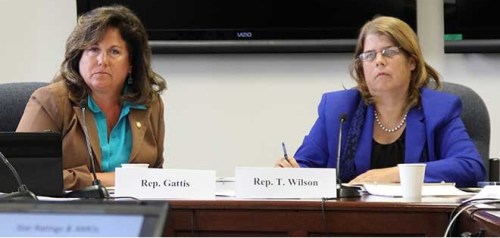
gattis-wilsonYesterday (Friday) Reps. Tammie Wilson and Lynn Gattis joined me during my stint as guest host on KBYR AM700‘s The Michael Dukes Show to reflect on the lessons learned from 2016 and talk about the issues going forward into 2017.

Both were members of the House Majority and sat on the House Finance Committee this past session.  Rep. Wilson will be a member of the House Minority and continue to sit on the House Finance Committee this coming session.  Rep. Gattis is not returning but intends to remain active on the issues.

The conversation provides a somewhat behind the scenes view of the how individual legislators responded to the state’s fiscal issues last legislature, how the legislative process dealt with those efforts and what effect that had on the subsequent election. Importantly, the conversation also addresses the assertion, by some, that “the legislature didn’t do anything” to address the state’s fiscal situation last session.

Going forward, the two discuss how the issues likely are to be dealt with this coming legislature and how, from their perspective, Alaskans can best participate in the process.

The podcast is here:

Senator Mike Dunleavy’s Fiscal Plan …

dunleavy-banner10Wednesday, during my run as guest host of KBYR AM700‘s The Michael Dukes ShowAlaska State Senator Mike Dunleavy joined us to preview the fiscal plan he proposes to introduce this coming session in his capacity as incoming Chair of the Senate State Affairs Committee and a continuing member of the Senate Finance Committee.

Despite a bit of self-induced technical difficulty on my end (we crashed into the top-of-the-hour hard break, a talk radio no-no), the Senator stayed with us to finish providing a full preview of the plan and give us the opportunity to ask a few questions.  With a bit of editing — to limit inflicting on listeners a full repeat of the technical difficulties — here is the podcast of the discussion in two parts.  The first is the opening in the 7am hour; the second is the continuation and wrap up in the 8am hour.

Part 1 (7am block segment)


Part 2 (8am block segment)