Category Archives: Immediate Reactions

Part 3 of the “Alaska’s Fiscal Future” curriculum saga …

letterReaders will be familiar with Parts 1 and 2 of the “Alaska’s Fiscal Future” curriculum saga.  If some need a refresher, here are links to Part 1 and Part 2.

Following Part 1 I had an extended and ultimately, good exchange with those responsible for curriculum at the Anchorage School District and became convinced that they understood the reason for and importance of including the ISER model as part of the materials they made available to teachers.  In the last communication ASD committed that “all teachers who attended ​[the previous breakout session] ​will be invited to attend a special training focused on the DOR model vs the Goldsmith model​ ….” Continue reading

The “Alaska’s Fiscal Future” curriculum saga continues …

letterYesterday I posted a letter that I had sent to Anchorage School District Superintendent Ed Graff and others on the rollout at an ASD in-service day last Friday of a new curriculum on “Alaska’s Fiscal Future.”  According to a press release issued by the Governor and posted by ASD on its website the day before, the new curriculum “centers on the Alaska Revenue and Expenditure Model developed earlier this year by the Alaska Department of Revenue.”

As I explained in yesterday’s post, I have significant concerns about DOR’s model.

As I received responses during the day from the Superintendent and others I came to realize that, while ASD was responsible for the Friday rollout and was listed in the press release as one of the developers of the curriculum, the issue extended as well to two other organizations that, according to ASD, played a larger role in developing the materials.

Those organizations are the University of Alaska – Fairbanks division of “eLearning  & Distance Education,” which appears to have set up a website containing the materials used by ASD entitled “Alaska’s Fiscal Future: Educational resources for solving Alaska’s fiscal challenges,”  and the Alaska Council on Economic Education, which describes itself as “a non-profit partnership of leaders in business, economics and education who are devoted to advancing the economic way of thinking so an informed public understands economics, shapes their future and advocates sound personal, local and national economic policies” and, according to ASD, helped set up the in-service day.  The Board of Directors of the Council is available here.

I have long admired and respected the efforts of both organizations and readily anticipate that their efforts in developing the curriculum are motivated by the best of intentions.  For the same reason as I outlined yesterday in my letter to ASD, however, their use and adoption of the DOR model as the “center” of the curriculum materials is problematic.

Consistent with my letter yesterday to ASD, this morning I sent a letter also to those involved in the effort at the UAF eLearning division and ACEE.  A copy follows:

My letter to ASD on the proposed curriculum on Alaska’s Fiscal Future …

letterLast Thursday Governor Walker’s office issued a press release announcing that, the following day at an in service training for some of its middle and high school teachers, the Anchorage School District intended to start rolling out proposed course materials “to bring Alaska’s fiscal challenge to the classroom.”  That was the first I, and from various reactions, a large number of others had heard about the intent to do so.

What caught my eye about the proposal was the following statement in the Governor’s press release:  “the lesson plans center on Alaska’s Revenue and Expenditure Model developed earlier this year by the Alaska Department of Revenue.”

As readers of these pages likely already realize I am not a fan of the Department of Revenue’s model.  As I wrote on these pages in June, in my view DOR’s model then was short-sited and strongly biased toward requiring new revenue options.  While there have been some improvements made in the model since the version I reviewed in that piece, it continues to contain limitations and deficiencies which continue to drive users toward those options.

More importantly, the model fails to identify and lead users to understand — and find pathways to solve — the structural defects in Alaska’s current fiscal model.  Following oil price and production ups and downs, Alaska’s historic fiscal approach repeatedly has led to boom and bust cycles in government spending over the last several decades.  Rather than address that fundamental issue, which goes to the heart of Alaska’s current fiscal situation, DOR’s model instead merely leads users to try to find ways to fill in the current bust cycle with “new revenues” — largely a PFD cap and broad based taxes. Continue reading

Weathering Alaska’s Fiscal Storm …

At the request of the University of Alaska-Fairbanks student group, Students Who Enjoy Economic Thinkingyesterday Dr. Scott Goldsmith and I walked through a discussion of sustainable budgets at a forum on the UAF campus.  The slide deck we used is above.

It was an interesting discussion, with excellent questions.  For those interested, a summary written by News Miner political reporter Matt Buxton is in today’s paper, here (“Keithley, Goldsmith talk sustainable budget“).  My favorite quote in the story is this, quoting Scott:

He said the state has often fallen into the trap of increasing budgets when oil tax revenue is high and painfully cutting when it collapses.

“What it means is we’re having a party and passing the cost of the clean up to the next generations of Alaskans. We have to ask ourselves, ‘Is that fair?’” he said.

The solution?  Well, read the slidedeck.

Alaska’s Fiscal & Economic Future …

“Here’s My Proposal” (1hr, 50 min)

Fashioning a Compromise (38 min)

Fashioning a Compromise (38 min)

While I work on this week’s Sunday Morning Note here are the segments from Saturday’s  (Sept. 19, 2015) forum on Alaska’s Fiscal & Economic Future that featured the “citizen proposals” offered by former Attorney General John Havelock, First Alaskans Institute CEO/President Elizabeth Medicine-Crow, former Senator Gary Wilken, and me.  A copy of the proposals prepared by each are available here.

The first segment (“Here is My Proposal”) is the presentation of the proposals, questions from the panelists to each other, and questions of the panelists by former Deputy Revenue Commissioner (among other things) Larry Persily, Legislative Finance Director David Teal and conference organizers Gunnar Knapp (Director of the Institute of Social and Economic Research) and Cliff Groh (Chair, Alaska Common Ground).

Following an announcement of the results of the polling conducted after the first segment, the second segment (“Fashioning a Compromise”) is a discussion among the panelists of the factors involved in reaching a compromise among the various positions, and an outline of what form a compromise might take.

My current “Top 5” #AKbudget priorities for the 2016 session …

In preparation for the coming week — the discussion today on Alaska Public Radio Network’s Talk of Alaska, a meeting this evening of the Alaska Republican Assembly and my participation in Saturday’s forum on Alaska’s Fiscal and Economic Future — I have been working to refine my focus for the coming 2016 legislative session (which will set the FY 2017 budget) to five top priorities.

Here is the slide deck that captures my current view.

The (much) better economic model for #AKFuture …

ISER Sustainable Budget Model

(Supplemental Note:  Following up on a reader’s suggestion, I published a brief supplement to this piece on 6.15.2015 to make available a couple of graphics reflecting the points made in the following piece.  The supplement is available at “Page Two” of this blog, here.)

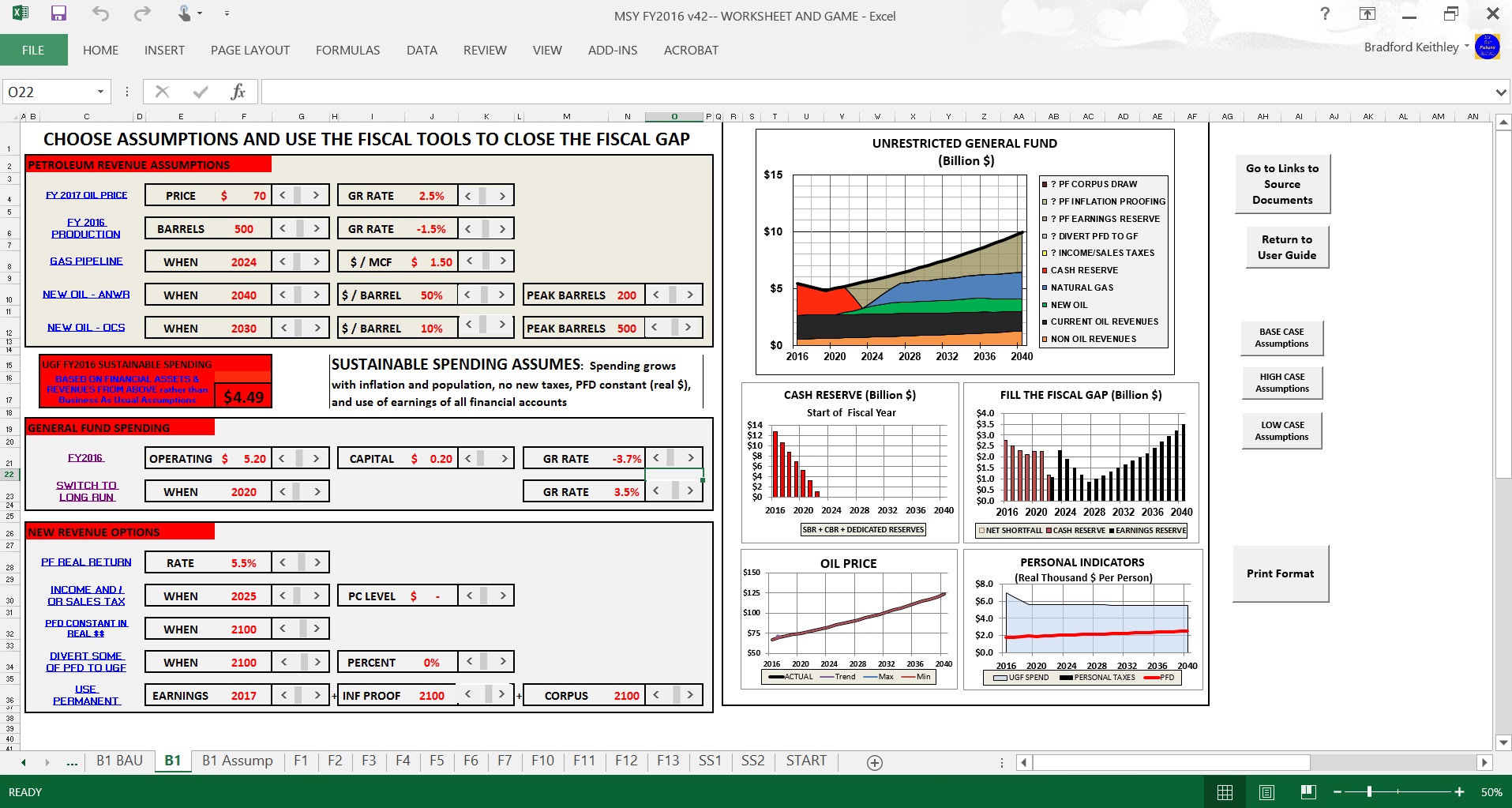
Yesterday, after the legislature finally completed work on and passed the coming year’s (FY 2016) budget, I spent a large part of the day working through the two publicly available economic models recently offered to help Alaskans understand and help plot where the state should be headed going forward.

The first I spent time with was that released last weekend as part of Governor Walker’s “Conversations with Alaskans”.  That model is available for download here (*see additional footnote below). 

The second was that released earlier this year by the University of Alaska-Anchorage’s Institute for Social and Economic Research, the best non-partisan economic think tank in the state.   That model is explained and available for download here.

There are significant differences between the two.  Continue reading

#ShellNo or #ShellYes: A Debate on Arctic Development

Yesterday, Rep. Charisse Millett, Majority Leader, Alaska House of Representatives, Kshama Sawant, a member of the Seattle City Council, Glen Hiemstra, a Futurist and I debated Shell’s Arctic exploration plans on The Stream, a globally broadcast online program from Aljazeera.

Interestingly, the debate mostly turned into a “Seattle trying to tell Alaska how to do things” discussion.  That never ends well for Seattle.

The background and some related materials are available here.  The full debate — which is about 35 minutes — is at the link above and worth the listen if you are interested in the subject.

Alaska’s Budget: Status, Background and Where We Are Headed Next

Earlier this month I was asked to make a presentation at the Annual Meeting of the Alaska Republican Assembly on the current state of Alaska’s budget.  A video of a portion of the presentation is at the top; the slidedeck I used below it.

Toward the end of the videotaped portion I was asked “if I were King” how I would deal with the resolving the current (FY 2016) budget stalemate.  The answer begins at 39:45 of the video.

Alaska’s Fiscal Challenge: How deep, how long, potential solutions and what they mean for Anchorage

Last month, Joe Riggs, a member of the Anchorage Mayor’s Budget Advisory Commission, and I were asked to make a presentation to the Commission on the current state of the Alaska state budget and the potential implications for the Municipality’s budget.

The conclusion?  Continuing reductions in state support, and, potentially, encroachment on the Municipality’s revenue options.  In other words, squeezed from both ends.

The slide deck we used is at the link above, or available here.