Category Archives: Alaskans for Sustainable Budgets

Finding Alaska’s Future: The FY 2018 Sustainable Budget (updated with video)

On Friday we rolled out Alaskans for Sustainable Budgets FY 2018 sustainable budget number in presentations in Fairbanks before the Interior Alaska Republicans, and in the MatSu Valley before the Alaska Republican Assembly.  The slide deck is above, as is a video of the presentation Friday evening before the Alaska Republican Assembly. (Note:  the video has been added subsequent to the publication of the original post.)

The roll out comes earlier than in past years, as a way of putting an updated, FY 2018 sustainable budget number in front of the Administration and legislators in advance of the election and subsequent organization.

The number is based on oil price projections made by the federal, and non-partisan Energy Information Administration in July of this year as part of its Annual Energy Outlook 2016.   While the state also publishes oil price projections, the latest one, published in the Department of Revenue’s Spring 2016 Revenue Sources Book, is significantly out of line with the EIA and other recent forecasts, came in the middle of a debate over whether Alaska needed so-called “new revenues” in which the Administration was pushing a tax and PFD cut narrative based in substantial part on a low oil price future, and thus, quite frankly, is of significantly questionable credibility and value.

Going forward, we at least will use — and will urge others to use — oil price projections published by reputable, non-partisan sources rather than those published by an Administration (whether Republican, Democrat or Independent) pushing a political agenda based on one view or another of oil prices.

The long term sustainable budget number for FY 2018 is $4.02 billion.  The material assumptions that go into the calculation are included on the slide deck.

There are two state fiscal issues that matter this election cycle and many candidates are getting one badly wrong …

fiscal-cliff-pulling-backAs we close in on the end of the first round of this election cycle — the primary is this coming Tuesday, August 16 — it is important to remember that there are two state fiscal issues that matter this year.

The first is how the candidate stands on state spending levels.  The second — injected into this cycle by the Governor and the Senate — is how the candidate stands on cutting the PFD.

Some try to minimize the second, arguing to one degree or another that the state’s financial condition is too far gone to be salvaged without permanently cutting the PFD and converting the difference to support state spending.

But that attempt to minimize the importance of maintaining the PFD is wrong and overlooks the fundamental reason both issues are important. Continue reading

The start of my 2016 Independent Expenditure effort …

Fiscal Cliff (pulling back)Starting today I am running some radio ads and, on Monday, will be putting up a digital campaign to support two candidates in the coming Republican primary. The ads will run through election day next week.

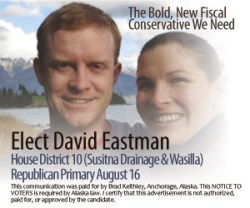
I explain my support for David Eastman in the House District 10 (Susitna River Drainage and Wasilla) Republican primary here.

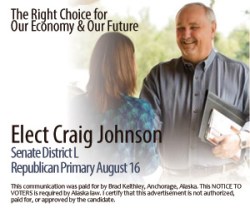
I explain my support for Craig Johnson in the Senate District L (South Anchorage) Republican primary here. Continue reading

Craig Johnson in Senate District L (South Anchorage)

300x250 CJI am supporting Craig Johnson in the Republican Primary in Senate District L.   Here’s my radio spot — that goes up today and will run through the election — to prove it.

The script, if you would prefer to read the ad rather than listen, is here.  A digital campaign, which links to this piece, will go up Monday.

Why am I supporting Craig?  Here’s the longer piece I published last week at Alaskans for Sustainable Budgets to explain it: Continue reading

David Eastman in House District 10 (Susitna River Drainage and Wasilla)

300x250 DEI am supporting David Eastman in the Republican Primary in House District 10.   Here’s my radio spot — that goes up today and will run through the election — to prove it.

The script, if you would prefer to read the ad rather than listen, is here.  A digital campaign, which links to this piece, will go up Monday.

Why am I supporting David?  Here’s the longer piece I published last week at Alaskans for Sustainable Budgets to explain it: Continue reading

Alaska’s Fiscal Situation: Past, Present & Future — an update

As regular readers will realize, at the request of Daniel Hamm, its Chair, we occasionally brief the Alaska Republican Assembly on the current status of state fiscal issues and our thoughts on how to deal with them.

We did that again this week, with a focus on what happened this past session(s), where that leaves the state’s fiscal condition, what the current outlook is as we start to think about FY 2018, and alternatives for dealing with that, admittedly somewhat initially dismal, outlook.

As explained in the presentation, I continue to believe there is a solid fiscal future ahead for Alaska — without resorting to permanent PFD cuts or significant taxes.  But it requires taking steps to implement Jay Hammond’s vision for Permanent Fund earnings and getting immediate control over what has become one of the biggest current expenses in state government — reimbursed oil credits.

This coming session may provide the last great chance to bring the state’s fiscal situation under control before more drastic measures become necessary.  The presentation outlines how we think that can be accomplished.

The update is above, or also available here (video) and here (slidedeck).

Why we need to halt the reimbursement of oil credits — and how …

Fiscal CliffThis column will not be popular with some readers. But it needs to be written.

As readers realize, Alaska is facing a significant financial challenge.  Part of that is self-inflicted by not tapping all available revenue sources.

Untapped revenue

As we have previously discussed on these pages, part of the Permanent Fund earnings stream always has been intended to be used to support government.  As former Governor Jay Hammond said when discussing his vision behind the Permanent Fund:

“I wanted to transform oil wells pumping oil for a finite period into money wells pumping money for infinity.”  Once the money wells were pumping, “[e]ach year one-half of the account’s earnings would be dispersed among Alaska residents …. The other half of the earnings could be used for essential government services.”

Inexplicably, instead of establishing a mechanism for doing just that, Governor Walker instead has done the one thing Governor Hammond strongly cautioned against — tapping the Permanent Fund Dividend, the portion of the “account’s earnings [otherwise to] be dispersed among Alaska residents.” This year the result is to have left roughly $1 – $1.25 billion in potential new government revenues on the table (50% of FY 2016 statutory net income), while at the same time taking roughly $650 million out of Alaska’s private economy.

The larger part of the problem

But the much larger share of the problem is driven by continued overspending.

As most readers will know, some legislators have claimed that the budget passed this Continue reading

Thursday’s “First Post” from Alaskans for Sustainable Budgets …

FB Ad Pic (with text)As some readers will realize from occasionally flipping through the Facebook widgets on the right side of this page, recently during this extended legislative session we have been posting somewhat extended pieces entitled “First Post” discussing issues related to Alaska’s fiscal policy.   Those pieces are available in full at the Facebook page for Alaskans for Sustainable Budgets.

Because we view this page as having a broader purpose we have not burdened this column with those daily posts. But given the significance of yesterday’s events — a series of line item vetoes by Governor Walker in advance of the start of next week’s Special Session — we are making an exception in this case and posting today’s “First Post” on this page in addition to the Facebook page for those readers who may follow this blog, but not the related Facebook pages.

Today’s column follows:

Thursday’s “First Post” from Alaskans for Sustainable Budgets: There will be several things to chew over from yesterday’s events as the state prepares for the start of next week’s Special Session, (a good summary of the day’s events is at http://goo.gl/YGN8y6), but we start with this.

While some will argue it is the case, Governor Walker’s actions yesterday in no way justify enacting ‪#‎permanent‬ changes to the Permanent Fund. The most significant “cut” he made (outside of the one-time ‪#‎PFDcut‬) — to‪ #‎OilCredits‬ — is not really a cut at all but a deferral of amounts which otherwise come due in FY 2017 into future years (or maybe, just to next Spring’s FY 2017 supplemental). Disappointingly given his previous statements, in an underreported event yesterday he even signed HB 247, which now codifies an extra $1 billion in spending (over the level which would have resulted in terminating the failed program) over the next four years on those very same credits.

The other cuts are much the same. Like the “cut” to #OilCredits, the “cuts” to school debt reimbursement (which drop the reimbursement levels below those provided by statute) are more a deferral than a permanent fix (which would require legislation). The additional cuts to K-12, the University and elsewhere similarly can be reversed in subsequent years (or again, even in next Spring’s FY 2017 supplemental). (A full list of the vetoes is at https://goo.gl/yzpAUT).

In short, the Governor didn’t cut spending so much as he masked it temporarily.

As we have made clear on these pages we do not support changing the calculation of the PFD in any event because of the adverse impact on Alaska’s private and overall economies. As we have said throughout, we believe the PFD is a stroke of economic genius designed by Jay Hammond and others to help replicate the effect of oil wealth on Alaska’s private and overall economy (through creating a private economy share of oil revenues) in the same way as occurs in the L48 producing states.

Moreover we do not buy in to Governor Walker’s (and others’) claims that you have to cut the PFD to save it. Those calculations are ‪#‎entirely‬ dependent on state spending and ongoing oil price assumptions that, in the case of oil prices, are inconsistent with the consensus projections of most analysts that understand these things, and in the case of state spending levels, are entirely, ENTIRELY, within the state’s own control. Losing the PFD isn’t inevitable as the Governor claims; it only occurs if this and subsequent legislatures continue spending at current, elevated levels.

But even for those that have said they would support restructuring the PFD if the state cut spending first, yesterday’s actions shouldn’t even remotely be enough to change their previous opposition. Making a #permanent change to the Permanent Fund on the basis of these one-year — if even that — deferrals and cuts would be the equivalent of falling for a cheap parlor trick. “Look these costs are gone,” would say the magician, “now give us a lifetime endowment for making that happen.” And then the moment he walks off the stage with the endowment — oops, there they are again.

Even if you favor “restructuring” the PFD based on spending reform, at least insist on receiving tit-for-tat. You want #permanent changes to the Permanent Fund, then insist on #permanent spending reform by changing the formulas and insisting on legislatively adopting real, permanent change to the state’s cost structure (e.g., the University consolidating into a single institution) that otherwise are driving spending. Don’t fall for the parlor trick of trading mostly one-time spending deferrals for #permanent PFD changes. That is a fool’s game.

Instead, if that is your view we suggest you let the Governor’s actions rest as they lie. He made one time “cuts” to state spending; then accept a one-time reduction to the PFD. If he (or you) want more, then do the hard work next session to make the legislative changes necessary to achieve similarly permanent reductions in the state’s cost structure.

For us, we hope that the ‪#‎AKLeg‬ summons enough votes to override the Governor’s one-time PFD veto. Almost the last thing Alaska needs as it heads into (if not already in) a recession is to take even more money out of the state’s overall economy by cutting the PFD. Applying the 1.4 factor developed in ISER’s March analysis (counting the knock-on effects, each $1 distributed through the PFD produces $1.40 in Alaska income), yesterday’s decision to cut $666 million from PFD distributions this coming fall will reduce OVERALL Alaska income by nearly $1 billion.

But in all events the absolute last thing Alaska needs is for these one time, largely spending deferrals to turn into a permanent reduction in Alaska income.

So, this is our reaction to the day’s events: We can live with a one-time cut if that is where it ends up. Just don’t fall for the parlor trick and turn it into something much, much — much worse.

How to finish this session: the movie (I mean, the video)

At the invitation of Daniel Hamm, on Tuesday evening of this week I spoke to the regular monthly meeting of the Alaska Republican Assembly on the current status of the Alaska budget in this legislative session.  The title of my presentation was “How to Finish This Session with a Sustainable Budget (and economy).”  A more detailed introduction to the presentation is here.  

Daniel went to the effort of filming (and perhaps the much greater effort of editing and uploading) the presentation and the Q&A session after. He has my most sincere appreciation for the effort.  The full video is about an hour and a half; perhaps more importantly, the Q&A session begins at about the 53:00 minute mark.  The YouTube is below and I have provided another copy of the slidedeck I used below that if you want to follow along.

How to finish this session with a sustainable budget (and economy): My presentation to the Alaska Republican Assembly

At the invitation of Daniel Hamm, the Chair, yesterday evening I spoke to the regular monthly meeting of the Alaska Republican Assembly.  Dan had asked that I brief the organization on the current status of the Alaska budget.  The title of my presentation was “How to Finish This Session with a Sustainable Budget (and economy).”

The presentation focuses on four issues:

  • What level of revenue should the budget use as a baseline.
  • Oil & gas tax credits.
  • The Operating & Capital budgets.
  • PFD cuts and other taxes.

Continue reading