Alaska Legislature — February 16, 2011 House Resources Committee Hearing

Important hearing before House Resources yesterday.  Oil industry presentations on the outlook for the industry and the potential impact of HB 110, the Governor’s proposed revisions to ACES. Continue reading
Australian LNG projects to cost $3,000/mt, require $80/b oil: report – Oil | Platts News Article & Story

Interesting article, with implications for Alaska LNG.  The $80/bbl price assumes that Asian LNG prices remain linked to oil.  Given the growth of shale gas, that may be an aggressive assumption.  If gas and oil prices became delinked, the risk associated with an LNG project becomes even greater. Continue reading

Alaska’s Future: Sen. McGuire’s proposed competitiveness review is important

Shortly after the start of the current Legislative session, Senator Lesil McGuire introduced Senate Concurrent Resolution 4, which would establish an “Alaska Oil and Gas Competitiveness Review Task Force.” If adopted — as it should be — the resolution has the potential to become one of the most significant pieces of long-term legislation passed this session. Continue reading

Natural Gas Plant: LNG Plant in Kenai to Shut Down – ktuu.com

Story from the AP posted a few minutes ago on KTUU: Natural Gas Plant: LNG Plant in Kenai to Shut Down – ktuu.com.

The gist of the story is this:   “ConocoPhillips and Marathon Oil Corp. plan to shut down the Nikiski liquefied natural gas plant in Alaska after more than 40 years in operation.  Officials cite deterioration in the LNG market for the decision.

This development has negative implications for Cook Inlet gas development, the Bullet Line and the Valdez LNG line (if the fully depreciated Kenai plant can’t maintain an existing position in the Asia LNG market, not likely a new build plant can penetrate the market).   A development that casts a long shadow.

New Report on Economics of Alaska Instate Gas Line

An article in today’s (February 9, 2011) Fairbanks News-Miner reports on a study by Roger Marks for the Office of Federal Coordinator, Alaska Natural Gas Transportation Projects.  The article, authored by Dermot Cole, is available here.

The lead paragraph does a good job summarizing the study’s conclusion:  “If the state wants to subsidize a gas pipeline, it could get far more benefit out of using its resources to help the economics of a large-scale pipeline instead of putting money in a small-diameter line from the North Slope to Anchorage.”  The full study is here.

My immediate reaction is that the study provides a good analysis as far as it goes.  However, the study necessarily accepts as a boundary that the instate line (due to provisions built into AGIA) is limited to 500 MMcf/d. If AGIA is terminated (as it should be), those limitations are eliminated and a different discussion around the instate line becomes possible.

Given that limitation, I would not rely at this point on some of the other conclusions contained in the study (for example, that hydro may be a preferable alternative for Southcentral) until the smoke clears on whether the 500 MMcf/d limitation is terminated.  If the limitation is terminated, the discussion around potential options will change.  Alaska shouldn’t lock into other alternatives until that fundamental issue is resolved.

The First Vote on Reforming ACES Goes Bad — and That’s Within the House “Majority”

An article posted yesterday evening in the Alaska Dispatch (see Alaska legislative leadership runs into political and personality problems,” Nov. 8, 2010) reports on votes taken over the weekend in connection with the formation of the new Alaska House “Majority.”  While the “leadership” is attempting to spin a serious disagreement that resulted as a “personality” dispute, in fact the vote that led to the disagreement appears to have been the first legislative vote on reforming ACES (which stands for “Alaska’s Clear and Equitable Share”), the Palin era tax increase that has been discussed extensively elsewhere on these pages.

My comment on the development follows the article, and is repeated here:

“To me, there is something much deeper — and far more troubling — going on here with these developments.   There are eleven members on House Finance — without much argument one of the two most important committees in the Legislature (the other being Senate Finance).  Certainly, any legislation materially affecting Alaska’s economy is going to go through that Committee. Continue reading

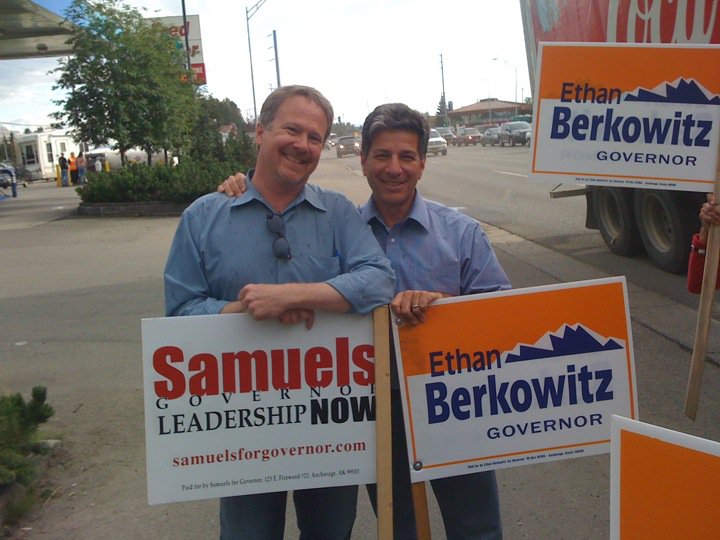
Alaska’s economic future: Berkowitz gets it, Parnell doesn’t

As the campaign for governor enters its final days, both candidates are focusing on the future of Alaska oil. That is a good thing, because as Gov. Parnell admits, “oil remains the backbone of Alaska’s economy” and that backbone is weakening rapidly.

By now, most are familiar with the basic statistics. Oil provides roughly ninety percent of state government general fund revenues and is responsible for one-third of the Alaska jobs.

Most also are familiar with the fact that oil production from the North Slope is down more than two-thirds since its peak in the late 1980s, and continuing to decline at a fairly rapid rate.

What many are not aware of, however, is how rapidly the decline is occurring. Continue reading

The Best Two … One Remains

Week Ending 10/1/2010: Estimated Alaska North Slope Netback Values

Market Bbl MMBtu
Oil $76.04/BOE $13.11/MMBtu
Gas (AGIA) Negative $2.01/BOE Negative $0.35/MMBtu
Gas (Valdez LNG) Negative $2.50/BOE Negative $0.43/MMBtu
Gas (Bullet Line) Negative $0.24/BOE Negative $0.04/MMBtu
Henry Hub
(netback reference for L48 gas)
$21.29/BOE $3.67/MMBtu

Beginning with prices posted on September 10, 2010, this page started including the “Henry Hub” price effective for the same day.  The reason for including that price is explained at “Reason for Adding the Henry Hub Price,” http://bit.ly/dj6oEo.  The remaining prices represent estimated values, netted back to the field level, for Alaska North Slope (ANS) oil and gas marketed through various options, based on closing prices for the relevant markets on the indicated day.  For an explanation of the basis for all of the estimated netback values, see “Basis for Estimates of Alaska North Slope Netback Oil & Gas Values (rev. Sept. 6, 2010),” (Sept. 6, 2010) http://bit.ly/cNqYw5.  Beginning with the week ending September 24, 2010, the estimated values are posted weekly, based upon the closing prices for Friday of the relevant week.

“Let’s call it … Alaska Oil Inc.” (Reprinted from Alaska Dispatch)

Let’s call it … Alaska Oil Inc.

Patti Epler | Sep 28, 2010

0927-alaskaoilIf the world’s biggest oil companies don’t want to pump what’s left of Alaska’s oil out of the ground, why not do it ourselves? We could create our own oil company — out of reach of the Legislature, of course — kick it off with a few billion dollars from a rainy day account, and put it to work on the North Slope.

It’s a simple premise for an obviously much more complex operation. But the idea pitched by Anchorage oil and gas attorney Brad Keithley at a recent weekend gathering of state, business and community leaders has generated a bit of a buzz.

Keithley says he’s gotten tired of hearing politicians say the state is running out of oil and that we need something else — a gas line primarily — to take its economic place.

“We’re not running out of oil, we’re running out of investment,” Keithley says.

As someone solidly in the oil companies’ corner, he blames the lackluster investment climate here on taxes and what he sees as the gouging of the industry that has come with ACES (Alaska’s Clear and Equitable Share), the 2007 state tax structure put in place by then-Gov. Sarah Palin with the help of legislative Democrats and now supported by Gov. Sean Parnell.

He points to industry reports that rank Alaska 129th out of 141 places in the world to make new investments in exploration and production. And he’s absolutely convinced the major North Slope producers will eventually walk away — at least for a considerable period of time — from billions of barrels that remain in the ground because the state’s tax system makes it a bad business deal. They simply won’t spend billions of dollars for new technology, equipment and infrastructure needed to get at heavy oil and the other difficult prospects that remain when they can get a better deal someplace else, he says.

“The decision about where to invest globally is based on ruthless economics,” Keithley says.

And yet, he says, there’s about as much oil left in Prudhoe Bay and neighboring fields as has been produced since operations began more than 30 years ago.

Alaska is uniquely dependent on oil revenue. It funds about 90 percent of the state’s budget and drives the economy. The state needs to develop the resource.

“The preference has been to have private companies take the risk but if they’re not investing here, then what?” he asks.

So now the pitch: The way Keithley sees it, there are two things the state can do to get the oil out of the ground. “The state can address the current investment climate to make Alaska more competitive and entice investment. Or we can do it ourselves.”

Doing it ourselves could look something like what happened in Norway 30 years ago. In 1972, when it couldn’t get major oil companies interested in exploring for and producing the country’s oil and gas resources, the government created Statoil, now one of the world’s biggest offshore oil and gas producers. A 2008 report by a Norwegian economic development agency said although the company has plays around the world, 85 percent of its revenue still comes from offshore operations in Norway.

“They knew they had oil but it wasn’t getting the attention from industry,” Keithley says. “So they created a state oil company that focused on developing the resource.”

Patience was one key to the company’s success, he says. A few dry holes in the beginning caused critics to contend it was a failure and waste of the public’s money. “But they drilled a few successful holes and it was off and running,” he says.

Norway also took control of the company out of the political arena, a factor that would be necessary in Alaska, too, Keithley says.


“If it becomes a political tool, it would fail,” he says, adding that legislative micromanagement would be a business nightmare.

To that end, Keithley also looks to the Alaska Railroad for inspiration. It’s a separate company initially funded by the state but that now generates its own revenue stream and operates independently with its own board of directors.

So would the state hire its own crew of geologists and engineers, roughnecks and roustabouts to drill, baby, drill on the North Slope? Maybe.

But there might be an easier way to dip the state toe in the oil pool.

“One way to think of it is to go in as an investor in resources and propose to partner with private companies” in exchange for an ownership interest, Keithley says.

He says that situation is known as “farming in” in the oil business, and he points to an example of that right here in Alaska. The Badami field was owned by BP, but the major oil company wasn’t finding it economically viable and shut it in a few years ago. So a small independent company, Savant Alaska, farmed in and has been developing the field. BP is still a partner.

Keithley, who represents BP along with other oil company clients in his job as an attorney at Perkins Coie, says he is not suggesting the state buy BP’s assets on the Slope, which have been rumored for months to be on the auction block.

But he does think industry would give a state investment serious consideration. “If somebody else is willing to put money in a tough environment industry would give it a fair assessment, a good hearing actually,” he says.

Keithley says he hasn’t given any thought to what it might cost the state to start its own oil company. And beyond noodling the idea into something he could talk about to a group of civic-minded policy wonks at a weekend retreat in Talkeetna, it’s not something he’s spent much time on, he says.

“I intended it in Talkeetna to be a thought-starter,” he says. “I didn’t intend it to be a definitive way forward.”

Scott Goldsmith, an economist with UAA’s Institute for Social and Economic Research, is one of those civic-minded wonks who was in the audience at the Talkeetna resort.

“I think it’s an intriguing idea that is worth studying,” he says. “The idea behind it is if the state really wants to get into the action, it’s another way.”

“In some ways it’s like getting some skin in the game,” he says, adding that it would require several billion dollars in capital investment.

“People were generally quite intrigued with the idea, I have to say. There was a sense among the groups that the Norwegians seemed to figure out how to do it, how to relate to the oil industry and get the maximum benefit out of their oil resources,” he says. “There wasn’t a lot of discussion on the pros and cons of it.”

He notes that the Permanent Fund is another example of a state-created company that operates independently. “The Permanent Fund corporation has been a growing success and is sort of an example of when things work.” Goldsmith also mentioned a few other state-backed ventures in communities around the state that haven’t worked so well.

State Department of Natural Resources officials didn’t return calls for comment. But Harold Heinze, who heads the voter-instituted independent Alaska Natural Gas Development Authority, was largely skeptical.

Heinze, a former president of ARCO Alaska Inc., says if you want to be in the oil business you have to be a good gambler and willing to take a lot of risks, especially when you have to make decisions on prospects that are 50-50 at best. “You’ve got to be smarter than the coin,” he says.

“It’s very difficult to see how that would work for a state entity, and neither our state bureaucracy or political system seems well attuned to risk,” he says.

He also cautions against competing with the private sector and points out that Statoil started out as more of a service and support company. “In Alaska, that would run straight into a very strong private sector.”

Mainly, he wonders what the state could do that the biggest oil companies in the world say they cannot. “There is a risk to ignoring the reading of the tea leaves by the industry. Especially when more than one company waltzes away from it, you ought to take a hard look.”

Contact Patti Epler at patti(at)alaskadispatch.com.